Ants
Small foragers, endless supply lines.
Ants are the most common call we get. A few scouts on the counter usually mean a colony of thousands is already established nearby — and killing the trail you can see does nothing to the nest you can't.
Where they come from
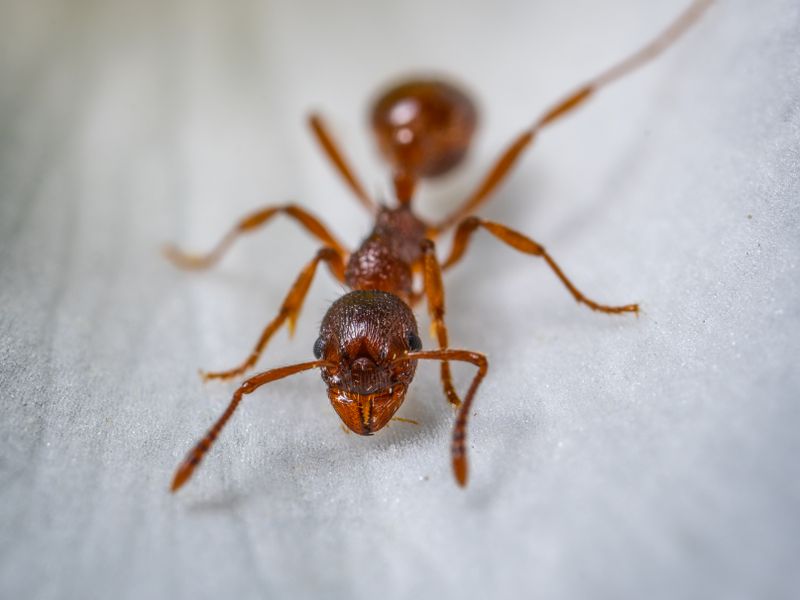
The Argentine ant, the species behind most local invasions, is native to the Paraná River basin of South America and arrived in the United States in the late 1800s. In California it now forms enormous multi-queen "supercolonies" that can stretch across entire neighborhoods. Carpenter ants and odorous house ants are also common here. Ants push indoors when the weather turns dry or after heavy rain, hunting for the water and sugars your kitchen provides.
Life cycle
Ants develop through complete metamorphosis — egg, larva, pupa, then adult — inside a colony of egg-laying queens, sterile female workers, and seasonal winged reproductives. Argentine colonies rarely swarm; instead they "bud," splitting off a queen and a group of workers to start a satellite nest a few feet away. That budding is exactly why over-the-counter sprays backfire: they scatter the colony into several new ones.
The damage they cause
Most ants are a contamination and nuisance problem, tracking bacteria across food-prep surfaces and getting into pantries. Carpenter ants are the exception — they don't eat wood like termites, but they excavate smooth galleries in moist or damaged framing to nest, and over years that tunneling can weaken structural wood. Ants also farm aphids in the garden, protecting them and making other pest problems worse.
Warning signs
- Steady trails along baseboards, counters, or foundation lines
- Small dirt piles or hills near the slab, driveway, or patio
- Winged swarmers appearing indoors, especially near windows
- Sawdust-like shavings (frass) below wood — a carpenter ant sign
- A faint rustling inside walls or door frames
We identify the species first, then use targeted baits that foraging workers carry back to the queens — collapsing the colony at its source — combined with treatment of entry points and an exterior barrier to stop re-entry.
Book your free inspection →